
Deciphering the Leap Between Land Clearing and Site Preparation
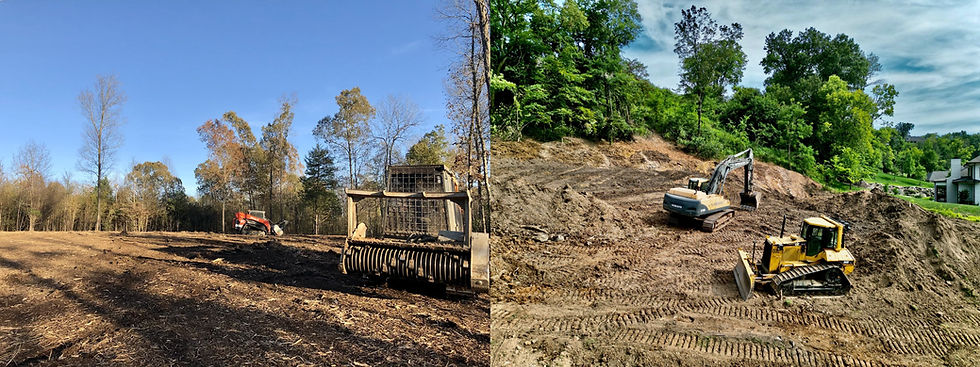
Stand at the edge of a raw, undeveloped parcel of land, and it’s easy to group all the heavy machinery work into a single, dusty category: the dirt phase.
For many property owners and novice developers, "land clearing" and "site preparation" are treated as interchangeable buzzwords. However, treating them as the same process is a costly misconception. Transforming a chaotic, wild environment into a mathematically precise anchor for construction requires two entirely distinct disciplines.
To put it simply: Land clearing is a battle against biology. Site preparation is a negotiation with physics.
Let’s break down the distinct anatomies of both phases and explore why understanding the line between them is critical for your project’s timeline, budget, and structural integrity.
Phase One: Land Clearing (The Extraction of the Organic Overburden)
Before a single blueprint can manifest in the physical world, the terrain must undergo a radical reset. Land clearing is the blunt-force extraction of whatever currently occupies the parcel. It is purely about subtraction.
You are not building yet; you are erasing.
What happens during this phase?
Biomatter Eradication: This goes far beyond simply felling timber. It involves the total extraction of dense brush, undergrowth, and invasive vegetation that crowds the work zone.
Sub-Surface Amputation (Stump Grinding and Root Removal): A common amateur mistake is cutting trees flush to the ground and leaving the root balls. As those roots decay underground over the years, they create subterranean voids, leading to catastrophic sinkholes. True land clearing rips this organic infrastructure out of the soil entirely.
Obstacle Evacuation: This includes the removal of massive boulders, derelict fencing, abandoned structures, and legacy debris hidden beneath the overgrowth.
The Goal: To create a blank, unobstructed horizon. By the end of this phase, the property is a chaotic, uneven expanse of raw, churned earth.
Phase Two: Site Preparation (The Earth-Engineering Stage)
If land clearing is tearing down the old world, site preparation is engineering the new one. Once the biological and physical hurdles are removed, the soil itself must be manipulated to accept the massive load-bearing demands of your impending structure.
Site prep is highly technical. It’s where topographical manipulation meets geotechnical science.
What happens during this phase?
Topographical Manipulation (Grading): The land must be sculpted to route stormwater away from the future foundation. This involves precision cut-and-fill operations—shaving down high elevations and moving that earth to fill in depressions.
Soil Compaction and Subgrade Stabilization: Loose, aerated dirt cannot hold a multi-ton structure. Specialized vibratory rollers are used to compress the soil to specific densities, squeezing out air pockets to prevent future settling.
Subterranean Infrastructure Trenching: Before foundations are poured, the earth must be opened up to lay the arterial networks of the property: deep drainage systems, utility conduits, and septic field lines.
Aggregate Introduction: Often, native soil isn't enough. Site prep frequently involves importing crushed stone or engineered fill to create a stable, non-shifting base layer beneath where concrete will eventually sit.
The Goal: To establish absolute structural viability. By the end of this phase, the chaotic dirt has been tamed into a mathematically sound, hard-packed, and perfectly sloped staging ground.
The Pivot Point: Why the Difference Matters to Your Project
Failing to distinguish between the extraction phase and the engineering phase usually results in budget blowouts. Here is why the distinction matters:
Equipment and Expertise Vary Wildly: A forestry mulcher and a fleet of excavators are perfect for clearing a wooded lot, but those operators might not hold the geotechnical knowledge required to shoot laser grades or achieve 95% standard Proctor compaction. You are often hiring different specialists for each phase.
Permitting Horizons: Municipalities generally view these processes differently. You may need an environmental permit for timber extraction (clearing) long before you apply for an earth-disturbance or grading permit (site prep).
The Hidden Costs of Transition: If your land clearing contractor leaves behind a jagged, deeply rutted landscape filled with uncompacted soil, your site prep costs will skyrocket as the next crew spends weeks fixing the terrain before they can even begin their actual work.
Finding a Partner Who Masters Both Disciplines
As mentioned, hiring separate crews for the extraction and engineering phases can lead to scheduling nightmares and massive transitioning costs. This is where partnering with a turnkey contractor who specializes in both disciplines becomes invaluable.
If you are developing property in Tennessee, American Excavation LLC is a prime example of a company that seamlessly bridges this gap. Operating since 2015, they bring the heavy-duty machinery required for aggressive land clearing and the geotechnical precision needed for structural site preparation. Because they handle the entire "dirt phase" from the first tree removal to the final grading, they eliminate the costly transition period between contractors.
American Excavation LLC serves a wide swath of Middle Tennessee, including:
Maury County: Columbia (38401), Spring Hill (37174), and Santa Fe (38482).
Williamson County: Franklin (37064, 37067, 37069), Brentwood (37027), Leiper’s Fork (37064), Primm Springs (38476), Arrington (37014), and the surrounding areas.
The Bottom Line
A successful build relies on respecting the sequence. You cannot engineer the earth while fighting the forest, and you cannot lay a foundation on recently ripped roots.
By treating land clearing as the violent necessity of removal, and site preparation as the meticulous science of foundation (and ideally hiring a contractor capable of managing both), you protect your investment from the ground up. The dirt phase isn't just a single hurdle—it’s the invisible architecture that dictates the lifespan of whatever you choose to build on top of it.
Ready to break ground? Whether you need to erase the overgrowth or engineer the earth for your next build, don't leave the most critical phase of your project to chance. Explore their Land Clearing & Excavation Services or learn more about their Site Preparation & Grading Expertise to get your project started on solid ground.


Comments