
The Right Way to Build a Gravel Driveway in Middle Tennessee


Key Takeaways
Avoid the "Dump and Spread": Dumping gravel directly over grass is a temporary fix that leads to sinking, mud, and wasted money.
Foundation is Everything: A lasting driveway requires excavating past soft topsoil down to the hard, native red clay.
Drainage is Non-Negotiable: Proper grading and drainage swales protect your driveway from washing out during heavy rains.
Layered Construction: Using a heavy base stone locked in with a finer top layer creates a tight, durable surface built for heavy loads.
Buying 10 acres in Leiper's Fork or a rural lot in Santa Fe is a dream come true for many Middle Tennessee homeowners. But before the custom home framing starts—or before you can even park an RV on the lot—you need a way to get from the county road to your build site.
For most rural properties, that means cutting in a long gravel driveway.
It is tempting to hire a truck to simply dump a few loads of gravel over the grass and spread it out. This "dump and spread" method is cheap upfront, but it is a guaranteed way to waste your money. By the time the spring rains hit, that gravel will have sunk completely into the mud, leaving you with a rutted, impassable mess.
Building a driveway that actually lasts in Middle Tennessee requires heavy dirt work, proper drainage, and a solid foundation. Here is exactly how American Excavation and Land Clearing does it right the first time.
Step 1: Clearing the Route
A long driveway rarely follows a perfectly clear, flat path. Before any rock is ordered, the route has to be carved out of the raw land.
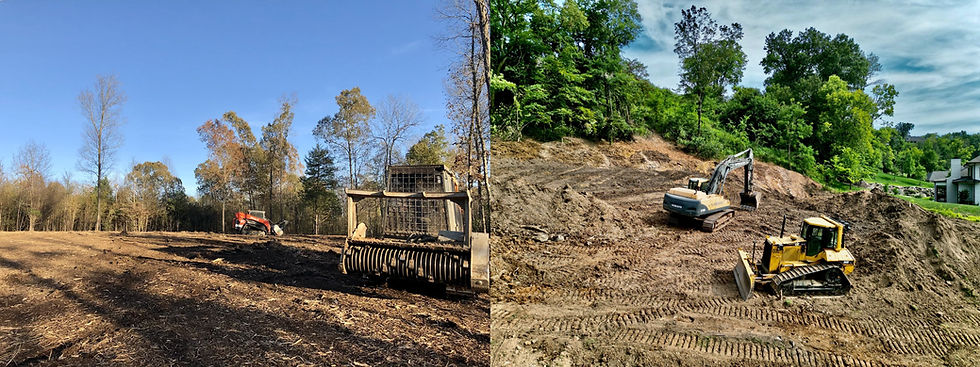
Using specialized heavy equipment, our team pushes over trees, pops out stubborn root balls, and clears out the dense underbrush. We don't just cut the trees down to the stumps; leaving stumps under a future driveway guarantees the ground will sink as the wood rots underground. We grind the organic material completely to ensure the path is structurally sound from day one.
Step 2: Excavating the Subgrade (The Secret to Longevity)
You can never lay gravel directly on top of grass or soft topsoil. Middle Tennessee topsoil is full of organic matter that holds water and compresses under weight.
To build a road that will support heavy concrete trucks, lumber deliveries, and daily commuter traffic, we excavate down past the soft topsoil until we hit the hard, dense red clay native to our area. This compacted clay acts as the true structural foundation of your driveway. Utilizing powerful track loaders allows us to efficiently move massive amounts of dirt and heavy base stone, even on custom build sites with tight access or uneven terrain.
Step 3: Grading, Drainage, and Fabric
Water is the enemy of a gravel driveway. If you don't control where the rain goes, it will wash your new stone right down the hill.
Once the subgrade is excavated, we use our machinery to grade the dirt with a slight "crown" in the center so water naturally sheds off to the sides. We also cut drainage swales or ditches along the edges of the driveway route to carry storm runoff away from the roadbed.
For high-end custom builds and areas prone to moisture, we take it a step further. You can often see our team prepping courtyard driveways by laying down heavy-duty geotextile fabric and corrugated drainage piping before the gravel base is ever spread. The fabric prevents the underlying mud from mixing with the clean stone, acting as a permanent barrier that keeps the driveway stable for decades.
Step 4: Laying the Base and Spreading the Stone
Only after the land is cleared, the subgrade is cut, and the drainage is established do we bring in the rock.
A proper driveway requires a layered approach. We start by laying and compacting a heavy base rock (often 3-inch to 4-inch surge stone) that locks into the clay and fabric. Once that heavy foundation is set, we spread a top layer of finer gravel (like crush and run) that packs down into a smooth, tight surface. While we leave the final concrete or asphalt pouring to paving specialists, this meticulous site prep ensures whoever comes next has a flawless, rock-solid foundation to work on.
Start Your Project on Solid Ground
A well-built gravel driveway is an investment in your property's accessibility and value. If you are preparing to build a custom home or need to establish access to your raw land in Maury, Williamson, or the surrounding counties, don't settle for a quick dump-and-spread.
Reach out to American Excavation and Land Clearing at (615) 573-5678 to schedule a consultation and get your project started on solid ground.


Comments